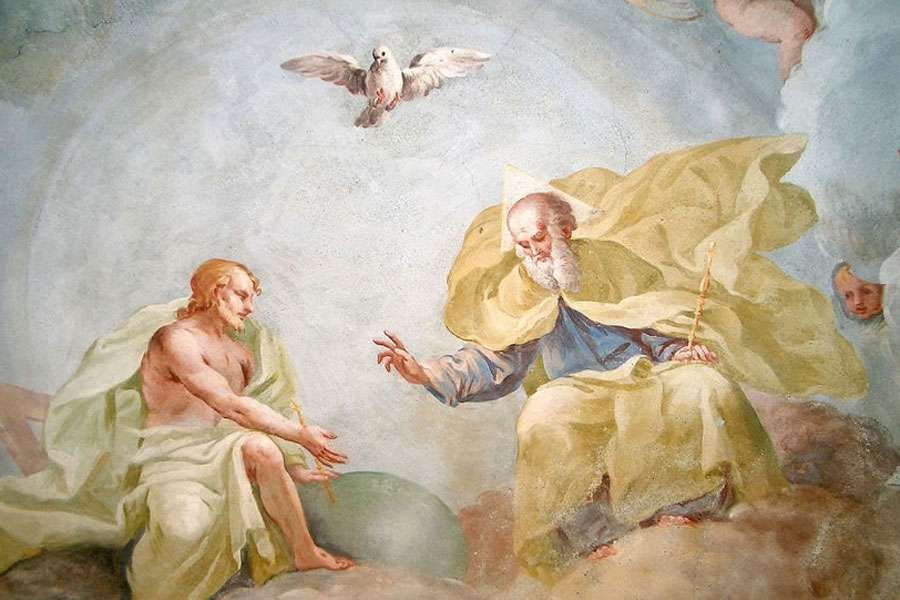
The Most Holy Trinity: Union in Love
by Fr. Tony Okolo C.S.Sp., V.F. | 05/31/2026 | Weekly ReflectionBeloved Parishioners,
Happy feast of the Most Holy Trinity. Today we are celebrating the mystery of our faith. May the Blessings of the Trinity, the Father, Son and the Holy Spirit fill every corner of your house and bring joy, peace, and good health to all. This blessing unites us with the past, present, and future. We celebrate with joy, God the Father, the Creator, the Son, the savior and liberator and the Holy Spirit, the counselor and consoler.
It is my earnest prayer that we may understand the Triune God as One-in the same moment in history Gen.1:22; 11:7; Matt.3:13-17, thus affirming what Karl Rahner, the German theologian, would say, “the economic Trinity is the immanent trinity and the immanent Trinity is the economic Trinity.”
The Church’s doctrinal teaching on the Most Holy Trinity is the heartbeat of our faith: God is One in Three divine Persons-the Father, the Son, and the Holy Spirit. “The Trinitarian experience is not an exotic one. It is embedded in each one of us. Life is a multilayered experience, but it does not destroy our uniqueness as a person with clear identity. We as individuals are made up of distinct attributes mind, soul, and body.” This doctrine is not a cold teaching preserved in dusty books, but a life-giving communion of eternal love. The Most Holy Trinity, like three notes forming one perfect harmony, reveals that at the center of our existence there is a relationship and love that must be maintained. We should not be divided by any sense of superiority or inferiority parallels, but united in love as the Trinity is united.
Saint Augustine, in his De Trinitate written between 400-420 AD brought clarity to the understanding of the Trinity through various analogies. One of these analogies is the “analysis of Love.” Imagine what love feels like in the family, workplace, school, etc. I guess it feels good, and we naturally want to experience it always and are even eager to share with others. St. Augustine sees the Father as “the Lover,” the Son as “the Beloved” and the Holy Spirit as “the Love of the Father and the Son.” This analysis suggests that human love involves the one who loves, the one who is loved, and the love itself. Hence, the three- relational dynamics are essential for a better society.
We can also consider St. Augustine’s “Principle of Appropriation,” which reminds us that our distinct roles and efforts in the Church make us one family in Christ. The distinct works: the Father as the Creator, the Son as the Redeemer and the Holy Spirit as the Sanctifier reveal the mystery of their eternal love by attributing to one Person what is common to all Three.
Beloved Parishioners, today I wish the theological and philosophical abstracts and turn towards how the exemplary life of the Trinity can guide our lives, because God is love and love is strongest when it is shared. As God is love and shared loved with the Son and Holy Spirit let us consider sharing love more than hatred and resentment. Let us learn from the mystery of our faith which is rooted in love and live in love in our families and with people we encounter.
I pray that every sign of the cross we make, as a symbol of our faith in the Most Holy Trinity, will become a silent sermon of this mystery of the Godhead, Amen.
BACK TO LIST